Wednesday, November 29, 2006
Tuesday, November 28, 2006
Monday, November 27, 2006
Richbrau shuts out turban wearer
A Sikh software executive visiting family in the Richmond area was denied entry Friday night to a popular Shockoe Slip restaurant because he refused to remove his turban.
Hansdip Singh Bindra, 37, was shocked when management at Richbrau Brewing Co. told him he had to remove his "hat."
"It was incredibly embarrassing. It's not a hat. When I wear a turban, it's a part of my body. It's a gift from God," said Bindra, who lives in Long Valley, N.J. "It's like asking a Jewish person to take off his yarmulke."
Richbrau owner Mike Byrne said yesterday that the restaurant's policy forbids head coverings.
"We have a policy where no bandanas or headgear is allowed, and we enforce it," he said. "I think the issue is he's quite clear on what our policy is. It's not a discrimination policy. It's simply no headgear."
Bindra was out with his two male cousins who live in Chester and a male friend, all of whom are Sikh but do not wear turbans.
The turban is a religious symbol for many Sikh men, who cover their long hair in public. Sikh men also wear beards. [Link]
DNSI
 direct link
Email post:
direct link
Email post:

Friday, November 24, 2006
Sikhs head for the barber and turn their backs on tradition
Western intolerance of religious symbols and a series of street attacks are prompting young men to shed their hair and turbans....
Many young Sikh men who have cut their hair say that they did so to escape the humiliation of turban searches at Western airports or to avoid being mistaken for Muslims.
They cite Balbri Singh Sodi, a petrol station owner shot dead in Arizona on September 15, 2001. His American killer, bent on revenge for 9/11, thought that Mr Sodi’s turban indicated that he was an Arab.
The Sikh community was shocked again this month when a gang of youths shouting racial abuse beat up a 15-year-old boy and cut off his hair in a public park in Edinburgh.
“It’s stupid, but the fact is most Westerners don’t know the difference between us and other turban wearers,” said one 31-year-old lawyer, who lives between Delhi and London and no longer wears the turban. “I’d rather blend in and not allow people to tell my religion on sight.”
But worrying as racist attacks are, Sikh elders are even more concerned by a broader official crackdown on overt expressions of religious identity in the West, especially in Europe.
Turbans have been banned from French state schools, as have Muslim headscarves, under a “secularity” law that came into effect in 2004. Last month a court in Denmark upheld a ruling that an Indian Sikh had broken the law by carrying his ceremonial dagger, the kirpan, in public. And last week, the Dutch Government prompted outrage from civil liberties advocates when it proposed banning the wearing of the burka in public. [Link]
DNSI
direct link
Email post:
Wednesday, November 22, 2006
FBI struggles to win trust of Muslim, Arab communities
For many Muslim and Arab-Americans these days, meeting a FBI agent can be an unsettling, even terrifying experience.
Beginning almost immediately after the Sept. 11, 2001, attacks, the FBI began to root out suspected terrorists, and Arab and Muslim communities became the bureau's top targets. Agents rounded up hundreds of people for questioning. They raided Muslim charities, monitored mosques for radiation and held refugees for months because of security checks.
To regain the trust of Muslim and Arab-Americans, the FBI has embarked on an aggressive national outreach program. The bureau's efforts, which include mosque visits and one-on-one meetings, have become so pervasive in certain cities that some young Muslim-Americans refer to the agency as the "Friendly Brotherhood of Islam."
Yet across the country, many participants wonder what the interactions achieve when mistrust remains the biggest obstacle. Some community activists compare the tone of the current encounters to those during the Red Scare of the 1950s, when U.S. citizens were singled out as suspected communists and expected to prove their loyalty to the United States. [Link]
DNSI
direct link
Email post:
Tuesday, November 21, 2006
WaPo: SALDEF Develops Federal Poster on Kirpans with DOJ
Feel frustrated when a jangling bracelet or pocket full of coins sets off security screeners as you make your way into a government building? Consider the Sikhs, whose religion requires them to always wear a dagger.
The centuries-old requirement has collided with beefed-up, post-Sept. 11 rules that no longer allow people to leave legal weapons and other banned items with security guards working in such buildings as courthouses and federal offices. In two dozen cases in the past two years, Sikhs have been arrested, threatened with arrest or harassed in disputes with guards over the ceremonial kirpan, according to the Sikh American Legal Defense and Education Fund.
In an effort to bridge the culture-security gap, the Homeland Security Department and the Sikh legal group yesterday unveiled a poster meant to help screeners through these interactions. The poster, which will be distributed to federal facilities across the country, shows photos of different kirpans, ranging from a symbolic necklace some women wear to the more common three- to six-inch daggers, as well as full-on swords. Sikhs often wear them under their clothing, bound to them by a cloth body holster.
The kirpan, one of five items baptized Sikhs are required to wear, is meant as a reminder of the duty to uphold justice. [Link]
DNSI
direct link
Email post:
Monday, November 20, 2006
Europe: A young generation of homegrown Muslims is challenging the region’s self-image
The debate about where or whether Islam belongs in Europe has become a conversational genre. To ban or not to ban headscarves in schools? Terrorism versus civil liberties? Whither multiculturalism? All worthy questions, you may say, but what do they have to do with charcuterie?....
The search for an answer, still far from conclusive, has emerged as the most passionately debated issue in European life. Not so long ago, Europe’s Muslims were left to wrestle with their own identity issues. Their job, as native Europeans saw it, was to assimilate—or not. That’s changed, utterly. Today the specter of terrorism, fairly or not, looms over the Continent’s Islamic communities; last week’s bombings in Turkey only intensified the fears and suspicions prevalent in many countries. That makes the question of how to integrate Europe’s Muslims both more critical—and far more difficult....
As Muslims gain the political confidence to assert themselves, and the skills to forge alliances with other groups, their impact on European culture and society can only grow. Even the reluctant French government is realizing that life in a globalized world may mean that Muslims—and, indeed, religion itself—cannot be kept in purdah. Nor can the broad cultural identities associated with religion and ethnicity simply be denied. The devout and the doubting, the radical and the secular, all may think of themselves as “Muslim,” and more and more they will assume their rightful place in the arts and the media, in parliaments and on village councils, in board rooms and on military promotion lists. [Link]
DNSI
direct link
Email post:
Saturday, November 18, 2006
Friday, November 17, 2006
Selected Criticism of Glenn Beck
The Huffington Post:What The Hell Is Wrong With Glenn Beck?
Glenn Beck at CNN interviewing the first Muslim congressman in American history says, "Prove to me that you are not working with our enemies." It's a pretty amazing thing to say (click on the link to see the video). The obvious question I would have for Glenn Beck, Prove to us that you are not working with our enemies.
Never mind the impossibility of proving a negative. The enemies I'm talking about are ignorance, intolerance, racism. The enemies I'm talking about are the people that don't want us to have a diverse, pluralistic society.
In the same breath Glenn Beck insists that he has been to many mosques and has many Muslim friends. Let me be the first to say, I doubt it. [Link] The Houston Chronicle:A low point in American journalism
When I first watched this clip of CNN's Glenn Beck interviewing Keith Ellison, just elected to Congress who will be the country's first Muslim Congressman when he takes office, I thought I was watching one of Stephen Colbert's "Better Know a District" segments from his satirical "faux news" show.
BECK: OK. No offense, and I know Muslims. I like Muslims. I've been to mosques. I really don't believe that Islam is a religion of evil. I -- you know, I think it's being hijacked, quite frankly.
With that being said, you are a Democrat. You are saying, "Let's cut and run." And I have to tell you, I have been nervous about this interview with you, because what I feel like saying is, "Sir, prove to me that you are not working with our enemies."
Unbelievable. Ellison, to his credit, handled it well.
Of course, given Beck's record of bias and inaccuracy perhaps someone should ask him to prove that he's really a journalist before CNN allows him back in front of a camera. [Link] Salon.com:
Fox isn't the only "fair and balanced" one
Who needs Fox News when you've got CNN's Headline News?
In an interview this week with Minnesota Democrat Keith Ellison, who was just elected as America's first-ever Muslim member of Congress, Headline News' Glenn Beck actually asked the following question:
"OK. No offense, and I know Muslims. I like Muslims. I've been to mosques. I really don't believe that Islam is a religion of evil. I -- you know, I think it's being hijacked, quite frankly. With that being said, you are a Democrat. You are saying, 'Let's cut and run.' And I have to tell you, I have been nervous about this interview with you, because what I feel like saying is, 'Sir, prove to me that you are not working with our enemies.' And I know you're not. I'm not accusing you of being an enemy, but that's the way I feel, and I think a lot of Americans will feel that way." [Link]
DNSI
direct link
Email post:
Video: Glenn Beck Asking Muslim Congressman to Prove he is not a Terrorist
DNSI
direct link
Email post:
DC Premiere of Divided We Fall
WASHINGTON, DC PREMIERE of
Divided We Fall: Americans in the Aftermath
www.dwf-film.com
Saturday, December 2nd at 4pm
George Washington University
1957 E Street (Building)
Washington, DC
Hosted by the Sikh Student Association at George Washington University in honor of the first Sikh teacher Guru Nanak Ji , Divided We Fall makes its Washington, DC premiere five years after the September 11th attacks. Dinner and Q&A with filmmakers Sharat Raju and Valarie Kaur follows the screening. Open to the public. Free admission. Co-sponsored by the Smithsonian Asian Pacific American Program.
About the film
When a turbaned Sikh man is murdered in the aftermath of September 11, 2001, a college student journeys across America to discover who counts as "one of us" in a world divided into "us" and "them." Armed with only a camera, Valarie Kaur encounters hundreds of stories never before told – stories of fear and unspeakable loss, but also of resilience and hope – until she finally finds the heart of America, halfway around the world , in the words of a widow. Weaving expert analysis into a personal journey and cross-country road trip, the film confronts the forces dividing a nation.
For questions, contact info@dwf-film.com
DNSI
direct link
Email post:
Thursday, November 16, 2006
Hindustan Times on DNSI's Valarie Kaur
Efforts and initiatives to promote cross-cultural understanding are vital for survival, sustenance and success in the globalised world. Genuine understanding and respect for each other's beliefs and traditions can no longer be optional. The murder of Alia Ansari in Fremont last month and other crimes of violence against Sikhs, Muslims, and other racial, ethnic, and religious groups since 9/11 in varied parts of US further reiterate that hate and bigotry are paths to perdition. In their response against such acts, people of Fremont observed a wear a hijab/turban day on Monday, November 13.
Besides such similar responses, other long-term efforts for promotion of cross-cultural understanding are the global need of the day. For adequate representation of South Asia in Stanford, a new Center for South Asia (CSA) has been created at the university, co-directed by Professors Carl Bielefeldt and Linda Hess.
This year, the center is co-presenting two films in the San Francisco International South Asia Film Festival titled Divided We Fall: Americans in the Aftermath directed by Sharat Raju and Stanford's Valarie Kaur and The Forsaken Land directed by Vimukthi Jayasundara.
In Divided We Fall, driven to action by the brutal murder of a man from her Sikh community in the aftermath of 9/11, Valarie Kaur sets out across America. Camera in her hand she crosses the country to discover who counts as "American" in a world divided into "us" and "them".
Whether on the streets of a still-shocked Manhattan, the steps of the US capital, or in the desert towns of Arizona, Valarie captures the untold stories of 9/11. In cafes, restaurants, homes, places of business and street corners across the country, people invite her into their lives and share their remarkable struggles with violence, fear and loss.
In her journey, she confronts the forces that divide people in times of crisis. How do we see one another? Who looks like an enemy? Who looks like an American? Who counts as "one of us". [Link]
DNSI
direct link
Email post:
Wednesday, November 15, 2006
Debate Over Muslim Women Wearing Veils in the United States
 In the United States, the veil issue has also been addressed in courtrooms. One case took place in October in the midwestern city of Detroit, Michigan, which has one of the country's largest Muslim populations.
Muslim businesswoman Ginnnah Muhammad went before a judge to contest a bill from a car rental company. The judge dismissed her case when she would not remove her veil.
"When the judge asked me to take my veil off in court, I felt inhuman," she said. But Judge Paul Parah said he needed to see her face to judge her truthfulness. "I have to balance that. These are very delicate issues."
In the southern state of Florida, several women were told they could not wear a veil for their driver's license photo.
Khadija Athman, from Kenya, works on Muslim civil rights issues for The Council on American-Islamic Relations, or CAIR, a Muslim civil rights group. "I think in terms of drivers licenses and passport photographs it's reasonable to ask a person to have their face shown because it's a form of identification,” she said. “There is no other way you can identify this person as this is the person who is in this picture in the first place."
Ibrahim Hooper, Communications Director for CAIR, says the Muslim holy book, the Quran, indicates women should dress modestly. He says many Islamic scholars say women should cover their heads. He also says they have the right to wear a veil.
"The vast majority of Muslim scholars, both past and present, have determined that the requirements for a Muslim's women's attire is to cover everything except the face and the hands. We're against any restrictions on religious attire, or any time that the state would try to impose a particular form of dress."
But some Muslim women, like author Asra Nomani, say the veil is a sign of oppression, making women faceless and powerless. She has written about her experiences being a Muslim woman in the U.S. and says she has been harassed by people at the mosque she attends for not wearing a headscarf.
"To me, the veil is a very, very frightening expression of control of women."
But Ginnnah Muhammad says, for her, wearing the veil is liberating. "This is my choice. I'm free. I'm happy."
Ibrahim Hooper says what a Muslim woman wears should be her choice. "No one should be forced into any particular attire. But if somebody chooses not to wear what is commonly regarded as Islamic attire, that's their choice, and they shouldn't be attacked or abused because of that."
The controversy over Muslim women's dress is not likely to end any time soon as the Muslim population continues to grow in the U.S., Britain and France and several other western countries. [Link]
DNSI
direct link
Email post:
Tuesday, November 14, 2006
100 Attend Wear a Hijab/Turban Day Event
 Samantha Keller of San Jose wrapped a pink scarf around her face Monday, covering her long, curly brown hair. The church-going Catholic donned a Muslim veil as part of a global social experiment to show that she respects other people's cultures and faiths.
``I didn't get any weird stares or feel ostracized,'' said Samantha, 15, a sophomore at San Jose's Presentation High School. ``My school is pretty tolerant, but I wonder how it would have been in the real world?''
She was among the few who took ``Wear a Hijab/Turban Day'' to heart.
The event officially kicked off at noon Monday when about 100 people attended a 30-minute ceremony in rainy, blustery weather in Fremont's Central Park. Most of the guests covered their heads for the gathering but took off their headgear afterward. Keller kept her scarf on all day....
The event was dreamed up by a handful of Fremont community activists in response to the Oct. 19 slaying of Alia Ansari, 38, an Afghan mother of six who wore a hijab the day she was killed. Muslim women cover their hair to show modesty.
Because Ansari had no known enemies, many perceive the brazen daytime shooting as a hate crime. Hijab-day organizers wanted to show Ansari's family, and the wider community, that Fremont is not a hateful place. [Link]
DNSI
direct link
Email post:
Monday, November 13, 2006
Two teens have been found guilty of manslaughter for killing two elderly Sikh men

Two young offenders were convicted of manslaughter Friday in the beating death of two elderly men, prompting distraught relatives to lash out at the justice system for throwing out a second-degree murder charge.
The two young offenders were convicted on the lesser charge of manslaughter, in addition to aggravated assault and robbery in the 2005 beating deaths of Mewa Singh Bains and Shingara Singh Thandi.
Justice William Grist said he could not convict the teens of the murder charge because there was no direct evidence that they intended to kill when they clubbed Bains, 82, and Thandi, 76, with a baseball bat in the washroom of Surrey's Bear Creek Park in July 2005.
The teens, who as young offenders may not be named, attacked Bains on July 18, 2005, and robbed him of $150. He died later in hospital while undergoing surgery. Thandi was targeted the following day and struck three times in the head with a wooden baseball bat. He suffered a heart attack in hospital that Grist ruled was a direct result of the trauma.
Grist convicted both teens of the robbery and assault counts for their attack on Bains and the manslaughter count for the brutal assault on Thandi....
Crown prosecutor Kris Pechet said the younger of the two can get a maximum of three years; two in jail and the third in the community. The older of the pair, who were ordered to face a sentencing hearing Nov. 23, will be sentenced as an adult, unless his lawyer successfully argues he should be sentenced as as a young offender. The teens have been in custody since their arrest in July 2005, meaning they would normally qualify for double-time credit against their sentence. [Link]
DNSI
direct link
Email post:
B.C. teens guilty of lesser charges in seniors' deaths
Distraught relatives of two slain Sikh seniors lashed out at the justice system Friday after two young offenders were convicted of manslaughter, aggravated assault and robbery, but acquitted of second-degree murder in the 2005 beating deaths of Mewa Singh Bains and Shingara Singh Thandi.
Two teens were charged with the robbery of Bains, the aggravated assault of Bains and the second-degree murder of Thandi. B.C. Supreme Court Judge William Grist said he could not convict the teens, aged 13 and 15, of the murder charge because there was no direct evidence that they intended to kill Bains, 82, and Thandi, 76, when they clubbed them with a baseball bat in July 2005.
Thandi, who was attacked July 19, died Aug. 6, while Bains, who was attacked July 18, died Sept. 3. Both assaults took place in in the public bathroom of a Surrey, B.C. park.
The two teens, who cannot be identified, sat expressionless in a packed New Westminster, B.C., courtroom as Grist read his verdict.
Outside court, tears streamed down the faces of family members as they said the youths will soon be out of jail.
"That means they can kill more people," said Jhalman Singh Thandi, son of one of the victims. "They are sending the wrong message to the youth." [Link]
DNSI
direct link
Email post:
Sunday, November 12, 2006
Book Review: Mecca and Main Street: Muslim Life in America After 9/11
 [Geneive] Abdo shows how 9/11 shook the world of American Muslims. Suddenly, they were seen by their neighbors -- and their government -- in the global context of Islamist terror. A combination of aggressive law enforcement, indiscriminate use of immigration laws and hyped-up prosecutions left Muslims in doubt about their place in society. Those who reacted by keeping their heads down (or veiled) to avoid attracting attention only exposed themselves to accusations of indifference to the tragedy -- or worse.
The net result, Abdo concludes, is a community increasingly inclined to separatism. Elsewhere, this has provided fertile ground for radicals such as Osama bin Laden. The United States is scarcely on a slippery slope to Europe's fate, but the security of our society, Abdo shows, now depends on a spirit of inclusiveness and generosity. In Washington, that means appointing more Muslims to government jobs, preserving civil liberties, being more attentive to their foreign policy concerns and making adjustments consistent with U.S. strategic interests. In our neighborhoods, that means an awareness that when we talk about Muslims, we are talking not about the enemy but about the person next door -- someone whose family, like those of other immigrants, came here to escape harsh and uncertain lives. [Link]
DNSI
direct link
Email post:
Wednesday, November 08, 2006
Tuesday, November 07, 2006
Documentary: Persons of Interest
After the Sept. 11 terrorist attacks, then Attorney General John Ashcroft ordered the FBI to detain anyone who may have been in contact with the men who were involved in hijacking three planes and crashing them in New York, Washington and Pennsylvania and killing more than 2,700 people.
Agents arrested close to 5,000 Arab and Muslim men, about 800 of whom were charged with violations of U.S. immigration laws. Most of the men were eventually released or deported. However, five years after his arrest, Ali Partovi still sits in an Arizona detention center.
The story of these men is told in “Persons of Interest,” a 2004 documentary by Alison Maclean and Tobias Perse that features interviews with the detainees and their families. [Link]
DNSI
direct link
Email post:
Pakistani Victim Of Hate Crime Calls For Federal Charges Against Attackers
A Pakistani man beaten on a Brooklyn street called for federal charges Monday against the five teens charged in the attack, speaking out for the first time since the attack two weeks ago. NY1's Shazia Khan filed the following report.
"They were raising slogans, ‘Muslim terrorists,’” explained Shahid Amber, a victim of a hate crime. “[They] started cursing me, [saying] go back to your country, scum bags, you just messed this country up and all that."
Amber recalled how it all began. He was eating ice cream in front of a Dunkin Donuts in Midwood, Brooklyn on October 29, when a group of teenagers started yelling ethnic slurs at him. The 24-year-old immigrant from Pakistan said the verbal assault soon became physical.
“One of them, he spit on my face,” said Amber. “As I was cleaning my face, I see a punch coming on my face with a brass knuckle.”
Amber was treated for a number of injuries, including a broken nose, and soon after, the police arrested five teens, all of them Jewish, and charged them with assault as a hate crime. But on Monday, Amber and his lawyers joined several community organizations to say that is not enough. They want the teens to face federal prosecution. [Link]
DNSI
direct link
Email post:
Monday, November 06, 2006
Teen prank turns into tolerance
David Huffman told police that it was just a prank gone wrong: On April 22, at a McDonald's in Tinley Park, he tapped a Muslim woman on the head, nearly pulling off her headscarf.The woman, a young mother with her children, didn't see it as harmless. She was scared and embarrassed; her faith had been attacked. She told police, and they called it battery. But in a twist that surprised everybody, a Cook County judge ordered the teen to undergo sensitivity training at the Chicago office of the Council on American-Islamic Relations, the nation's largest Muslim civil rights organization. During the past three months, Mr. Huffman, 18, has spent 40 hours listening to and talking with Muslims across Chicago. He has completed required tasks that, at times, seemed ripped from reality television: watching Muslim youths play basketball, attending a 9/11 event and visiting area mosques. [Link]
DNSI
direct link
Email post:
Saturday, November 04, 2006
Thursday, November 02, 2006
A Vision of Hope
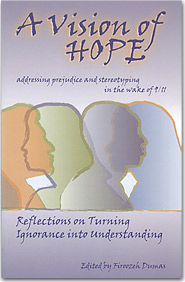 In A Vision of Hope — a slim new book edited by Dumas and published by I-House — 10 essayists describe similar instances of prejudice and hatred, this time in the wake of 9/11, and how they chose to react so as to "turn ignorance into understanding." ....
An anonymous African doctor, in another entry, describes a deadly attack, in the aftermath of 9/11, in northern Nigeria, where Christian and Muslim residents have a long history of bitter relations. In the title story, a Sikh from the San Joaquin Valley, Mansheel Singh, describes the taunting and hatred he endured as a sophomore in high school following the terrorist attacks of 9/11 — and the strengthening of his Sikh identity as a consequence. He was not alone in his ordeal. To deal with a rise in hate crimes against people wearing the Sikh turban, he writes, "Sikhs across the country were quick to do everything in their power to show their solidarity with America. Sikh-owned taxi cabs and gas stations were decorated with U.S. flags. Some Sikhs went so far as to wear red, white, and blue turbans." [Link]
DNSI
direct link
Email post:
Wednesday, November 01, 2006
|
|


 1531 Cambridge Street